25 Nov 2026
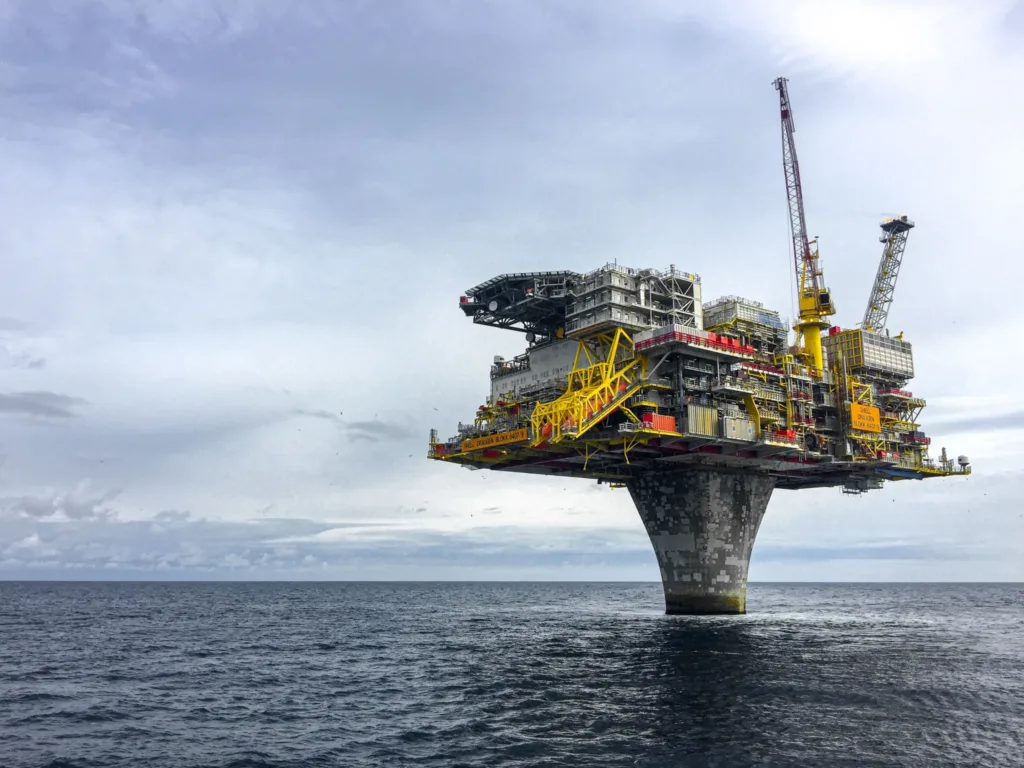
Alloy 825 is widely used in oil and gas drilling because it withstands the three main threats found in a well: hydrogen sulfide (H2S), carbon dioxide (CO2) and chlorides. Its high nickel content protects it against stress corrosion cracking, while molybdenum and copper limit pitting. For Alloy 825, Oil and Gas service in aggressive environments is a common application, qualified under NACE MR0175 / ISO 15156.
Alloy 825, sold under the trade name Incoloy 825 and designated UNS N08825, is an austenitic nickel-iron-chromium alloy. In other words, it has a face-centered cubic crystal structure, which makes it ductile and non-magnetic.
Its typical composition is as follows:
A production well combines several chemical and mechanical threats that act at the same time.
A well is called “sour” when it contains H2S. This gas promotes sulfide stress cracking (SSC), a brittle failure caused by hydrogen absorbed into the metal. Dissolved CO2 forms carbonic acid, which causes rapid general corrosion of carbon steels.
Formation water, often highly saline, brings chlorides. They attack the passive layer of stainless steels and initiate pitting and crevice corrosion.
Pressure and temperature rise with depth. Add chlorides and mechanical stresses such as tension, internal pressure and residual welding stresses. Together, these factors promote stress corrosion cracking (SCC), a form of cracking that progresses without visible metal loss.
With about 40% nickel, Alloy 825 is above the threshold at which austenitic alloys become largely immune to chloride SCC.
Molybdenum and chromium give it good resistance to pitting and crevice corrosion under seals, threads and deposits.
The alloy retains its mechanical properties from cryogenic temperatures up to about 540 °C (1,000 °F). Thanks to titanium, it can be welded without significant loss of resistance to intergranular corrosion.
A wellscreen, or sand control screen, holds back sand grains from the formation while letting oil or gas flow through. Without it, sand erodes production equipment and can plug the well.
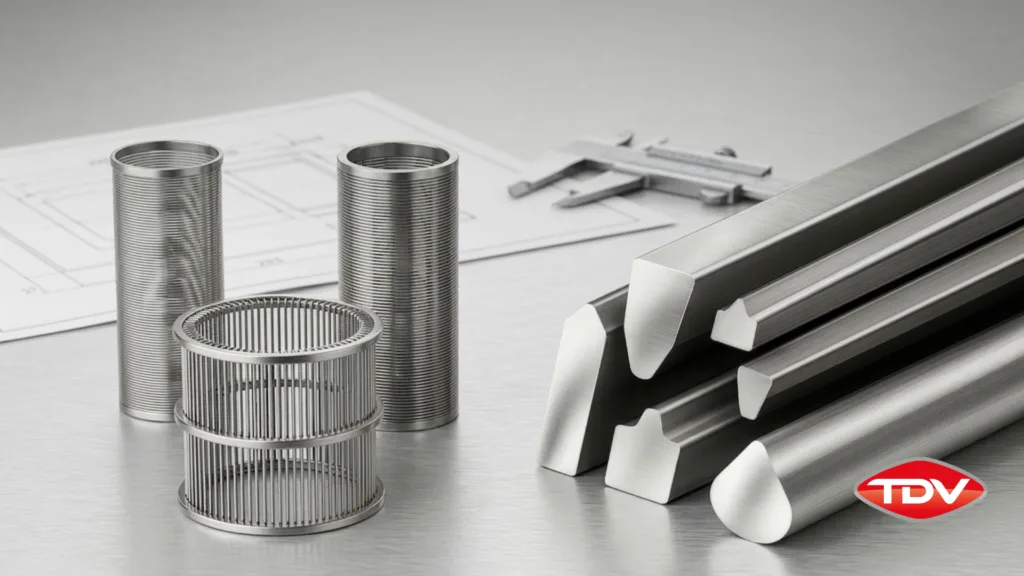
In a wire-wrapped screen, a profile wire with a trapezoidal cross-section, known as V-wire or wedge wire, is wound helically and welded onto longitudinal support rods. The gap between two turns forms a continuous slot, sized to the grain size of the formation sand.
The V shape widens the slot towards the inside. A particle that passes the opening therefore does not get stuck, which limits plugging and maintains flow.
Wellscreen wire is thin and in constant contact with well fluids. Even slight metal loss from corrosion is enough to widen the slot and let sand through. In sour or chloride-rich wells, Alloy 825 is therefore one of the materials offered for wellscreens, alongside 316L stainless steel and duplex grades.
| Material | Resistance in H2S + chloride environments | Relative cost | Typical use |
|---|---|---|---|
| Carbon steel | Low against CO2 and chlorides; requires inhibitors or a corrosion allowance | Low | Mildly corrosive wells |
| Duplex stainless steel (e.g. 2205) | Good in chlorides, limited in H2S | Medium | Moderately sour wells |
| Alloy 825 | Very good in H2S, CO2 and chlorides | High | Sour and corrosive wells |
| Alloy 625 | Superior, including at high temperature | Very high | Most severe conditions |
Carbon steel remains the economical choice as long as the environment allows it, and duplex grades tolerate H2S less well. Alloy 625 goes further, but at a much higher cost. Alloy 825 therefore sits in between and is often chosen as the best compromise for sour wells.
For Alloy 825, Oil and Gas drilling is a natural field of application. Its nickel-iron-chromium composition, complemented by molybdenum, copper and titanium, addresses the main degradation mechanisms found in a well. The final choice depends on actual reservoir conditions and on the limits set by NACE MR0175 / ISO 15156.
TDV Profile manufactures filtration profiles used to build wellscreens.
Are you designing control screens or Oil & Gas equipment?