26 Nov 2026

On September 4, 2026, the French National Institute of Industrial Property (INPI) granted patent FR3165796 to TDV Profile. This laser welding patent protects the LPW (Laser Pressure Welding) process used to weld ventilation spacers onto ventilation plates for air-cooled motors and generators. The innovation was developed by Olivier Jacquel, Technical and Industrial Director at TDV Profile.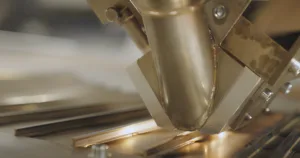
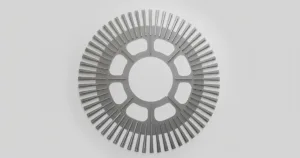
The rotor and stator of an electric machine consist of a stack of magnetic steel laminations. When the machine operates, these laminations heat up. To dissipate this heat, air is circulated between the laminations.
This is the purpose of ventilation plates: metal sheets onto which ventilation spacers are welded. These spacers create regular gaps through which air can flow. They are used in high-power machines, generally above 3 to 4 MW, ranging from ship propulsion motors (15 to 20 MW) to power plant generators (approximately 1,700 MW).
| Component | Common materials | Key considerations |
|---|---|---|
| Spacer (square, rectangular or I-shaped cross-section) | Mild steel or stainless steel 302HQ, 304L, 316L | Stainless steel must have very low magnetic permeability (≤ 1.2) to avoid interfering with the magnetic field |
| Magnetic steel sheet | Mild steel, sometimes 304L or 316L stainless steel, often coated with insulating varnish | Must remain flat; thickness ranges from 0.5 to 1.5 mm |
Today, most spacers are attached using spot welding (resistance welding). This method generates significant heat, which can deform thin sheets. It often leaves a small raised area on the underside of the sheet, requiring subsequent machining. It is also difficult to weld stainless steel onto magnetic steel using this method. When working with varnished sheets, the coating must first be removed, which adds time to the process.
Conventional laser welding works by passing the laser beam through the sheet to reach the spacer. This causes significant heating and can lead to deformation. A raised bead of metal forms on the surface and must be polished after welding. The two components must also be held firmly together, which can be difficult to guarantee.
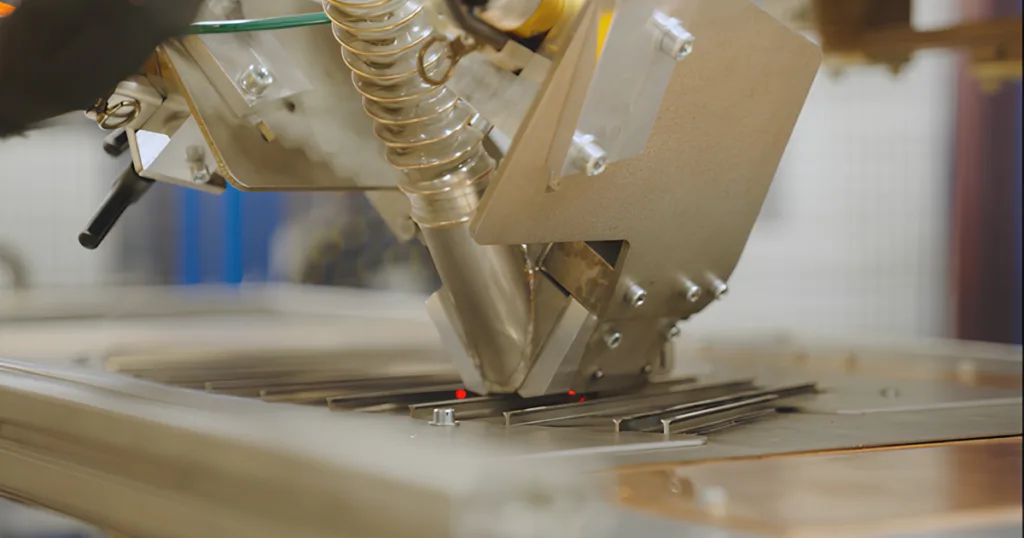
With the LPW process, laser welding is performed from the spacer side, along its edges, without passing through the sheet. During welding, a wheel or pressure finger presses down on the spacer to hold it firmly against the sheet. The underside of the sheet therefore remains smooth.
The welding head is equipped with two 1 to 1.5 kW lasers, one on each side of the spacer. They operate simultaneously or one after the other. A gripper picks up each spacer from a feeder and positions it on the sheet. An extraction system removes welding fumes and helps cool the assembly. A copper plate positioned beneath the sheet absorbs the heat.
The welding head is controlled by a CNC system operating on at least three axes. Welds can be continuous or segmented, aligned opposite each other or staggered, on one or both sides. Their number and length can be adapted to meet each customer’s specifications.
First and foremost, the process improves weld quality through optimized contact between the spacer and the sheet. The underside of the sheet remains smooth, eliminating the need for polishing or additional machining. With no excess material between the sheets, the stack maintains its clamping pressure: LPW welding prevents pressure losses within the laminated stack. As the process generates significantly less heat than resistance spot welding or conventional laser welding through the sheet, and the copper plate absorbs welding energy, sheet deformation is considerably reduced, even with thicknesses ranging from 0.5 to 1.5 mm.
The process makes it possible to weld stainless steel spacers onto magnetic steel sheets, as well as onto varnished sheets without removing the coating. It works equally well with all spacer geometries, including square, rectangular and shaped profiles. Using two welds, one on each side, secures the spacer across its full width, providing greater resistance and reducing the risk of tilting compared with a single central weld.
Weld configurations can be tailored to the required mechanical strength. Welding can be performed on one or both sides, continuously or in segments, with aligned or staggered welds. Weld length is adjusted according to customer specifications. Pressure is easily adjusted using cost-effective equipment.
In production, spacer positioning is automated: the gripper picks them up from a feeder and places them on the sheet according to the welding program, with no manual handling between components. The welding head contains no wear parts, ensuring consistent quality from one production run to another. The workstation remains clean and safe, as the extraction system captures welding fumes and adjustable side enclosures contain the laser beam.
Finally, the process also delivers significant cost savings.
By avoiding the thermal expansion effects associated with resistance spot welding, ventilation plates can be made from the same material as the other laminations in the stack, allowing them to be manufactured in large production runs at a lower cost. The process also eliminates several additional operations, including varnish removal before welding and polishing or machining afterwards.
An innovation that builds on our long-standing industrial expertise and our Vosges-based manufacturing know-how.
Do you have a project involving spacers or ventilation plates?